Physical Address
304 North Cardinal St.
Dorchester Center, MA 02124
Physical Address
304 North Cardinal St.
Dorchester Center, MA 02124

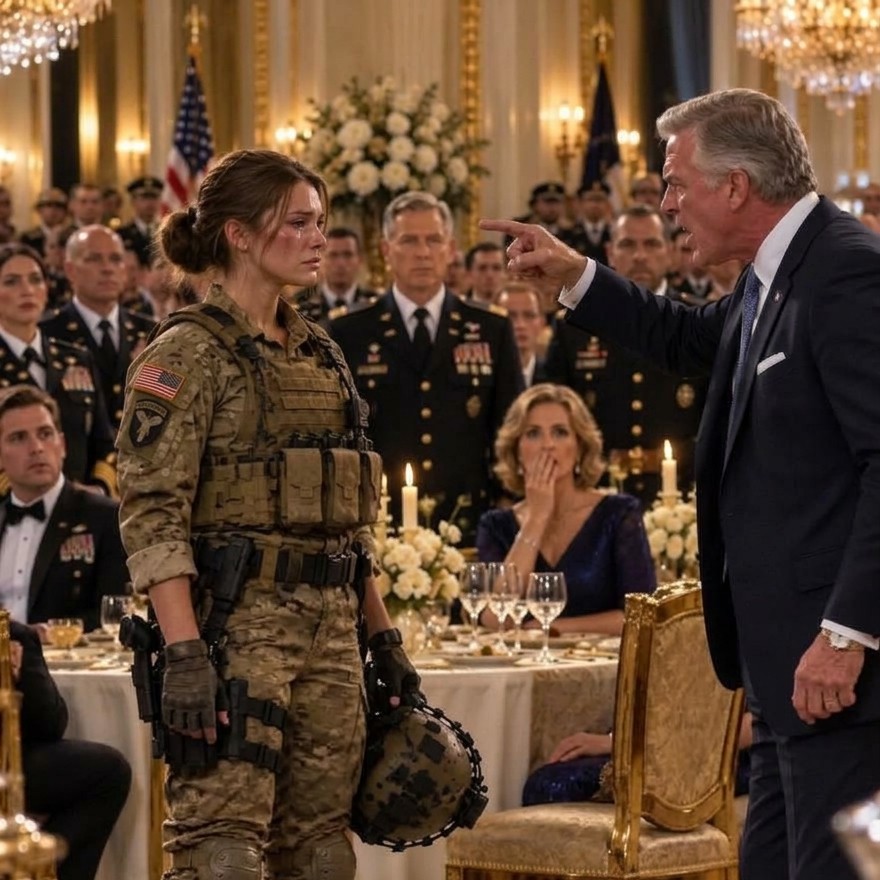
After forty-eight straight hours on a high-risk rescue mission, I walked through my father’s front door covered in dirt, smoke, and someone else’s blood. He looked me up and down in front of thirty dinner guests and said, “Just looking at you is an embarrassment.” What he didn’t know was that, before the night ended, the Joint Chiefs were about to say my name—and everything he thought he knew about me was going to collapse.
For a moment, no one moved.
Then Amanda took my coat from my shoulders.
Come upstairs, she said quietly.
You need to sit down.
I’m fine.
You’ve been saying that since you were seventeen.
The words were gentle, but they landed harder than my father’s insult.
I followed her toward the staircase, aware of every pair of eyes tracking us.
The guests began speaking again in low voices, pretending not to watch.
My boots left faint marks on the marble, and I heard someone murmur that the caterer should send a cleaner.
At the foot of the stairs, Dad called after me.
Evelyn.
I stopped.
His voice had changed.
It was no longer performative.
He sounded irritated, but beneath it was something else—uncertainty, perhaps.
He had spent decades mastering boardrooms, negotiations, and difficult men.
He had never learned what to do with a daughter who walked into his house carrying a world he could not control.
Whatever happened tonight, he said, you could have called.
I turned slightly.
I did.
His brows drew together.
When?
Yesterday morning.
Twice.
The color in his face shifted.
I didn’t see it.
You didn’t call back.
One of the guests glanced at him.
Dad noticed and straightened.
This is not the place for this conversation.
No, I said.
It isn’t.
Amanda touched my elbow, guiding me up the stairs before the moment could become another performance.
Her old bedroom was now a guest room, painted pale blue with a white quilt folded neatly at the foot of the bed.
A framed photograph of Amanda and me stood on the dresser.
We were twenty-two and eighteen, sunburned from a summer at the lake, our arms linked around each other’s shoulders.
I looked younger than I remembered.
Amanda closed the door.
Sit.
I lowered myself onto the edge of the bed.
The exhaustion I had been holding back began to spread through me, heavy and undeniable.
My body had stayed upright through instinct and training.
Now, in the quiet of the room, it seemed to remember every hour I had spent awake.
Amanda disappeared into the bathroom and returned with a damp cloth and a small medical kit.
You have a cut above your eyebrow.
It’s superficial.
You’re not allowed to diagnose yourself while I’m here.
I’m not a patient.
You’re my sister.
That’s worse.
She carefully cleaned the dried blood near my temple.
Her hands were steady, but her eyes kept returning to my face.
What happened?
Vehicle extraction.
Structural collapse.
We had civilians trapped in an office complex.
Were they all right?
Most of them.
She paused.
Most?
I looked toward the window.
Rain blurred the lights of the garden below.
One man didn’t make it.
Amanda lowered the cloth.
I’m sorry.
I nodded once.
The words were simple, and because of that, they reached me.
She sat beside me.
Was the blood yours?
Some of it.
That’s not what I asked.
I glanced down at my sleeve.
It belonged to a local medic.
He was injured when part of the ceiling came down.
We got him out.
He’ll live.
Amanda exhaled, relieved.
Then why did you say ‘some of it’?
Because I also had a cut.
How bad?
Not bad.
She gave me a look.
Evelyn.
Stitches.
Maybe.
She opened her mouth, but a knock interrupted her.
Neither of us answered.
The door opened a few inches, and Daniel stood in the hall.
He was younger than me by three years, though lately he looked older.
His hair had thinned at the temples, and his expensive shirt was wrinkled around the collar.
He had always been the quiet one in the family, but quiet did not mean unaware.
Daniel noticed everything.
He simply rarely acted on what he noticed.
Amanda, he said, Dad wants to know if Evelyn is staying.
Amanda’s face hardened.
She just got here.
I know.
Then you know she needs rest.
Daniel looked at me.
There’s a room prepared.
I’m not staying.
Why not?
The question sounded more personal than he intended.
I stood.
The room swayed slightly, and Amanda reached for my arm.
Because I have to report back in three hours.
Daniel frowned.
You’re going back tonight?
That’s the plan.
You’ve been awake for two days.
Almost.
That’s not reasonable.
Neither is sending people into collapsing buildings.
We do what needs to be done.
He looked away.
There it was again—that careful distance he wore around me.
Not disapproval exactly.
Fear, perhaps.
Or guilt.
When we were children, Daniel had followed me everywhere.
He had slept on the floor outside my room during thunderstorms because he said the hallway was safer.
At thirteen, he had asked me to teach him how to tie a proper knot.
At twenty, he had stopped calling.
I had never asked why.
Some questions became heavier the longer they remained unspoken.
I’ll take you home, he said.
I can drive.
You shouldn’t.
I didn’t come here to be managed.
No, he replied.
You came here because Dad invited you.
The remark was mild, but it carried an accusation.
I looked at him.
He invited me to his birthday dinner.
I assumed that meant he wanted me here.
Daniel’s jaw tightened.
He did.
Did he?
Amanda glanced between us.
Both of you, stop.
Neither of us spoke.
From downstairs came the muted sound of laughter, followed by the clink of glasses.
The party had resumed without us.
Perhaps that was the Carter family’s greatest talent: returning to normal before anything uncomfortable had been resolved.
Daniel stepped into the room and closed the door behind him.
Dad didn’t know you were coming tonight.
I stared at him.
He sent the invitation.
He sent one six weeks ago.
You declined.
I was deployed.
He thought you would stay away.
I almost laughed.
Then why invite me?
Because it was expected.
By whom?
Daniel rubbed a hand across his face.
By him.
By everyone.
That answer explained nothing.
I walked to the window.
From there, I could see the terrace where Dad hosted business dinners, charity auctions, and political fundraisers.
A row of lanterns glowed beside the wet stone path.
Beyond it, the river reflected the lights in broken lines.
Did he tell you not to come?
I asked.
Daniel did not answer immediately.
That was answer enough.
Amanda looked at him.
Daniel?
He said he didn’t want the evening complicated.
A quiet ache moved through me—not surprise, exactly.
More like confirmation.
And yet here I am, I said.
He didn’t mean it that way.
How did he mean it?
Daniel’s expression shifted.
You know how Dad is.
I know how he behaves.
He was nervous.
I turned around.
About what?
Daniel looked at the floor.
About tonight.
His birthday dinner?
Not only that.
The room seemed to narrow around us.
What else is happening tonight?
Nothing.
You just said—
I said he was nervous.
That doesn’t mean there’s some secret.
Daniel.
He met my eyes then, and I saw the same thing I had noticed downstairs: he was carrying information he had not decided whether to share.
Amanda crossed her arms.
You’re both being ridiculous.
If there’s something we need to know, say it.
Daniel gave a humorless smile.
That has never been how this family works.
For the first time that evening, I saw Amanda’s expression change.
She had always believed she could keep peace if she stayed calm enough, kind enough, useful enough.
But even she knew there were rooms in our family where none of us had been invited.
What is Dad hiding?
I asked.
Daniel moved toward the dresser and picked up the photograph of Amanda and me.
Nothing that concerns you.
Then why are you looking at that picture?
He turned it over.
The back of the frame was marked with a small strip of blue tape.
Beneath it, in faded ink, was a date.
October 14, 2004.
I knew the date.
My mother’s funeral.
I had not seen that photograph in years.
Amanda must have found it in storage and brought it upstairs without realizing what was written behind it.
Daniel set it down carefully.
Dad’s been receiving letters, he said.
What kind of letters?
Official ones.
From whom?
He hesitated.
Military offices.
Government agencies.
I don’t know exactly.
My heart gave one hard beat.
Why would they write to him?
They aren’t all addressed to him.
Then who are they addressed to?
Daniel looked at me.
You.
The rain seemed louder against the glass.
Amanda shook her head.
That doesn’t make sense.
Evelyn’s official correspondence goes through the base.
Not these.
What do you mean, not these?
I asked.
Some arrived here.
Why?
I don’t know.
You opened them?
No.
But Dad did.
Daniel didn’t answer.
I understood anyway.
How many?
Three.
Where are they?
Evelyn—
Where?
He looked toward the door.
Downstairs.
Amanda stepped closer to him.
Did Dad receive something tonight?
Daniel’s silence stretched.
A sudden vibration came from my pocket.
My phone.
The screen showed a secure incoming call.
I glanced at the number and answered immediately.
Carter.
A male voice came through, clipped and precise.
Major Carter, this is Colonel Reyes.
I moved away from the others.
Go ahead.
Are you at a secure location?
No.
Can you relocate?
I’m at my father’s house.
There was a pause.
Then listen carefully.
The briefing has been moved forward.
What briefing?
The one concerning your commendation.
I looked at Amanda and Daniel.
They could not hear the voice, but they saw my expression change.
When?
Twenty-one hundred.
That’s in less than an hour.
Yes.
Why the change?
Because the chairman wants the citation read before the full committee meets tomorrow.
I stared at the rain-darkened garden.
Colonel, I’ve been awake for forty-eight hours.
I need medical clearance before I can—
You’ll have it.
There is another matter.
His tone had lowered.
What matter?
Your name appeared in a document connected to the Harrow evacuation.
My shoulders went still.
The Harrow evacuation had been classified.
Only a small number of people knew the full operation details.
What kind of document?
That’s what we’re trying to determine.
Who has it?
We don’t know.
A chill settled behind my ribs.
Then why call me?
Because the document contains a notation that appears to have originated from your family.
I looked at the photograph on the dresser.
What notation?
Your mother’s name.
The room seemed to lose its air.
Amanda saw my face and came toward me.
What happened? she mouthed.
I lifted one hand.
Colonel Reyes continued.
Evelyn, did your mother ever have any connection to the Carter Foundation’s overseas relief programs?
My mother died twenty-two years ago.
That wasn’t my question.
I don’t know.
Find out.
Why?
Because the same foundation appears in a financial file attached to the Harrow operation.
I glanced toward the closed door.
Downstairs, my father was surrounded by people who believed they knew him.
People who raised glasses to his generosity and business judgment.
People who had never seen the way he avoided my mother’s name.
Colonel, what exactly does this have to do with me?
We’ll discuss that at the briefing.
Bring any personal records you can access.
Personal records?
Letters.
Journals.
Anything your mother may have left behind.
My fingers tightened around the phone.
She died when I was eighteen.
I don’t have her records.
Your father may.
The call ended.
For several seconds, I remained still.
Amanda reached me first.
What did he say?
Nothing I can explain yet.
Evelyn.
Your father has letters addressed to me.
Daniel’s face lost its color.
I told you—
You said they were official.
They are.
What do they say?
I don’t know.
You said you didn’t open them.
I didn’t.
But Dad did.
Daniel looked toward the door.
Where is he keeping them?
In his study.
Then we’re going downstairs.
Amanda caught my arm.
You can’t confront him in front of thirty guests.
I’m not planning to.
Your phone call—what was it about?
I looked at her.
Our mother.
Neither sibling spoke.
Amanda’s grip loosened.
For years, we had avoided the subject by agreement without ever making one.
Our mother had died suddenly after a short illness, and Dad had refused to discuss the details.
The official explanation had been complications from pneumonia.
There had been a funeral, a closed casket, and a house emptied of her belongings within a month.
I had been eighteen.
Amanda was sixteen.
Daniel was twenty-one.
We had each mourned her in our own private language.
Now, after two decades, her name had appeared in a classified military document.
It was too precise to be coincidence.
We left the room together.
The party had grown louder downstairs.
Dad stood near the fireplace, surrounded by three men from his former company and a state senator’s wife.
He was telling a story about buying his first factory, and everyone laughed at the appropriate places.
He saw us on the stairs.
His eyes went first to me, then to Daniel.
He stopped speaking.
The shift was barely visible, but I noticed it.
My father had always been good at hiding discomfort from strangers.
He had never been good at hiding it from me.
I descended slowly.
Dad, I need to speak with you.
He glanced at his guests.
Of course.
Privately.
His mouth tightened.
Now?
Yes.
Amanda and Daniel followed me into the library.
Dad closed the door behind us.
The library smelled of leather, cedar, and the pipe tobacco he no longer smoked but still kept in a drawer.
Shelves covered every wall.
His collection of military histories occupied an entire case near the window, though he had never served.
He went to the drinks cabinet.
Would anyone like something?
No, I said.
His hand rested on the cabinet handle.
You always did have a talent for making an entrance.
I’m not here to argue.
That would be a first.
Amanda stepped between us.
Dad.
He looked at her and softened slightly.
What is it?
I kept my voice controlled.
Have you received correspondence addressed to me?
For a moment, he appeared genuinely confused.
Then the confusion vanished.
Who told you?
Daniel.
Dad turned toward my brother.
You had no right.
Daniel’s voice was low.
She deserved to know.
She deserves many things.
That doesn’t mean you decide when to give them to her.
What are the letters?
I asked.
Dad ignored me.
You promised me, Daniel.
Daniel’s face hardened.
I promised not to open them.
And you promised not to involve your sisters.
I didn’t involve her.
You did, the moment you kept them.
Dad looked back at me.
His expression had changed completely.
The irritation was gone.
In its place was something older and more fragile.
You should not be asking about this tonight.
Why?
Because you’re exhausted.
That doesn’t answer me.
You’ve just come from an operation.
And you have documents addressed to me.
Evelyn, listen to me.
No.
You listen.
Colonel Reyes just called and said my name appeared in a classified file connected to the Harrow evacuation.
He said the file also contains a reference to the Carter Foundation and our mother.
Amanda drew in a breath.
Dad closed his eyes.
Only for a second.
But it was enough.
You knew, I said.
I knew there might be a connection.
What connection?
The foundation funded medical transport in several regions.
Your mother worked with them.
You told us she was a volunteer.
She was.
Then why would her name be in a military file?
I don’t know.
That’s not true.
His gaze met mine.
No, he said quietly.
It isn’t.
The admission settled over the room.
Amanda moved closer to him.
What aren’t you telling us?
Dad walked to his desk and opened the top drawer.
He removed a thin black folder and placed it on the polished wood.
The folder was worn at the edges, as if it had been handled many times.
I received these over the past year, he said.
Why didn’t you tell us?
Because I didn’t know whether they were legitimate.
You opened them.
Yes.
What did they say?
He slid the folder toward me.
Inside were three envelopes, each bearing an official seal.
The first was addressed to Evelyn Carter, Major, United States Army.
The second carried my civilian address.
The third had no return address at all.
My name was written on each in different hands.
I lifted the first envelope.
The seal belonged to the Department of Defense.
Why were they sent here?
Because someone believed this was still your legal residence.
That stopped being true twenty years ago.
I know.
I opened the first letter.
The page contained only a few paragraphs.
I read it once, then again.
It referred to an archival review of Operation Harrow, requested by a senior oversight office.
It stated that certain records had been recovered from a private collection connected to the Carter Foundation.
At the bottom was a sentence that made my fingers go cold.
One handwritten annotation appears to identify Major Evelyn Carter as the intended recipient of a sealed personal memorandum prepared by Dr.
Margaret Carter in October 2004.
My mother’s name.
Her handwriting.
The date of her funeral.
I looked up.
What is this?
Dad lowered himself into the chair behind the desk.
I don’t know.
You expect me to believe that?
I know what I found.
I don’t know why she wrote it.
Where is the memorandum?
His silence answered before he did.
It was not included.
Then what do you have?
He opened the second drawer and removed a small envelope.
It was yellowed with age, sealed with dark blue wax.
The wax bore a symbol I did not recognize: a narrow circle crossed by three lines.
My mother had worn that symbol once.
I remembered it suddenly—not on jewelry, but stamped into the corner of a leather notebook she kept beside her bed.
I had been twelve when I asked her what it meant.
She had closed the notebook and said, It’s a reminder that some promises outlive the people who make them.
I had forgotten the words until now.
Dad placed the envelope on the desk.
This arrived six months ago.
Why didn’t you send it to me?
Because the letter inside was not for you.
I stared at him.
Then whom was it for?
He looked toward the window, where rain traced the glass in thin, wavering lines.
For the person who would eventually understand why your mother left.
Amanda’s voice broke the silence.
Left what?
Dad did not answer.
I reached for the envelope.
The wax seal cracked beneath my thumb.
Inside was a single folded page, written in a familiar hand.
The first line was enough to make my breath stop.
Evelyn, if you are reading this, then the Carter Foundation has failed to keep its promise—and your father has finally run out of time.
The handwriting was unmistakable.
I knew the slight tilt of the letters, the long crossbars on her t’s, the way she pressed harder at the beginning of each sentence as though the words had to be anchored to the page.
For a moment, I could not read beyond the first line.
Amanda moved beside me.
What does it say?
I handed her the page.
She read silently.
Her expression shifted from confusion to disbelief, then to something more fragile.
Daniel remained near the door, watching our father.
Dad sat behind the desk with both hands folded in front of him.
He looked older than he had downstairs.
Not merely tired or unsettled, but diminished, as if the years he had spent holding this secret had finally become visible in the space around him.
I took the page back.
The message continued beneath the opening sentence.
Evelyn, if you are reading this, then the Carter Foundation has failed to keep its promise—and your father has finally run out of time.
I do not know how old you will be when these words reach you.
I hope you are old enough to understand that leaving was not the same as abandoning you.
I hope you are old enough to know that I loved you every day, even on the days when I could not come home.
My vision blurred.
I blinked and forced myself to continue.
There are things about my work your father does not know, and things he knows but has chosen to carry alone.
Neither choice was fair to him, and neither choice was fair to you.
The foundation was created to move medical supplies and emergency personnel into places where official channels could not move quickly enough.
At first, it was exactly what it claimed to be.
Then certain people began using it for other purposes.
I discovered that transport records were being altered.
Supplies were being diverted.
Names were being added to manifests by people who had no right to be there.
I tried to report it, but the people involved were not outsiders.
They had access to our offices, our accounts, and our trust.
Amanda pressed a hand to her mouth.
I kept reading.
Your father believes he failed me because he did not insist that I stop.
He is wrong.
I chose to continue because I believed I could protect the people who depended on us.
I was also afraid that if I walked away, the truth would disappear with me.
If this letter reaches you, the truth has not disappeared.
It has only been waiting.
At the bottom of the page was a final paragraph.
Do not trust the copies.
Find the original ledger.
It is where I told you it would be, though you were too young to understand what I meant.
Beneath that, she had written a sentence that made the room tilt.
The first promise was made beside the river, under the blue door.
There was no signature.
Only the small symbol from the wax seal.
Amanda lowered herself into the chair opposite Dad.
She knew this would happen?
Dad looked at her.
She knew something might.
You said you didn’t know why she wrote it.
I didn’t know she had written that.
You opened the envelope, I said.
The envelope arrived sealed.
I read the outer documents, not this.
Why not?
Because I was afraid.
The honesty in his voice unsettled me more than any denial would have.
I placed the page on the desk.
You knew Mother was investigating the foundation.
I knew she had concerns.
You knew she believed someone was stealing from it.
I knew she was worried about the accounts.
Those are not the same thing.
No, he said.
They aren’t.
Daniel stepped away from the door.
What happened in October 2004?
Dad’s gaze moved toward the rain-streaked window.
Your mother told me she had found irregularities in the foundation’s overseas accounts.
She believed someone had created false transport records to conceal the movement of money and medical supplies.
Did she tell you who?
I asked.
No.
You never asked?
I did.
She said she needed proof before naming anyone.
That sounds like her, Amanda whispered.
Mom had always been careful with names.
Even when we were children, she disliked careless accusations.
If one of us said a classmate had cheated or lied, she would ask, What do you know, and what do you suspect?
She made a distinction between the two and expected us to do the same.
Dad leaned back in his chair.
She wanted to travel to one of the regional offices and review the records in person.
I told her to wait.
She said waiting was how people like that survived.
People like what?
Daniel asked.
People who believed no one would look closely.
A silence settled over us.
I looked again at the letter.
Why did she leave?
Dad’s face tightened.
She told me she was going to meet someone.
Who?
She wouldn’t say.
You let her go?
The question escaped before I could soften it.
Dad did not defend himself.
Yes.
When?
October fourteenth.
Early morning.
The date of her funeral.
The date written on the back of the photograph.
She died that day, I said.
No.
His answer was quiet.
The word seemed to move through the room.
Amanda stood.
What do you mean, no?
Dad looked at each of us.
Your mother did not die on October fourteenth.
My hand gripped the edge of the desk.
The death certificate—
Was issued under another name.
Daniel stared at him.
Dad.
I was told she had been killed in a vehicle accident near the river.
I was shown photographs, identification, medical records.
The authorities said the remains were too badly damaged for an open casket.
My heart began to pound.
You said she died of pneumonia.
I know.
You told us she had been sick.
I know what I told you.
Why?
Dad’s hands trembled once before he clasped them together.
Because I was given a choice.
I could accept the official story and keep you safe, or I could ask questions and put all of us at risk.
Amanda’s voice was barely audible.
You’re saying the woman we buried wasn’t Mom?
I’m saying I was never allowed to confirm it.
The room felt unreal.
The shelves, the rain, the dark wood beneath my hands—everything remained exactly as it had been, yet the past had shifted beneath us.
I had spent twenty-two years grieving a death.
Now I did not know what I had grieved.
Who gave you the choice?
I asked.
People connected to the foundation.
That isn’t an answer.
It is the only one I had.
Did you believe them?
At first.
And later?
Later, I believed nothing.
Amanda turned away, arms wrapped around herself.
Why didn’t you tell us?
Because you were children.
I was twenty-two, Daniel said.
You were barely out of college.
I was an adult.
You were her son, Dad replied.
You were angry, frightened, and determined to find someone to blame.
If I had told you what I suspected, you would have gone looking for answers without understanding who might be watching.
Daniel’s expression hardened.
You should have trusted me.
I should have trusted all of you, Dad said.
But I was trying to keep you alive.
The words did not erase the years of silence.
They did not make the decision right.
But they were not the words of a man trying to win an argument.
They were the words of someone who had lived with uncertainty so long that it had become part of his identity.
I looked down at the letter.
What does the blue door mean?
Dad’s expression changed.
You remember it?
I remember Mother mentioning it.
You were twelve.
I remember a notebook.
He nodded slowly.
She kept a blue leather notebook.
It contained names, dates, locations, and account numbers.
She called it her field ledger.
Where is it?
I don’t know.
You said she told you something.
She told me that if anything happened, I should go to the old boathouse on the east bank.
There was a blue door.
Did you go?
Yes.
When?
The night after the funeral.
You went alone?
I had no choice.
Was it there?
The boathouse had been abandoned for years.
The door was blue, but the building was empty.
Then why did she write that the ledger was where she told me it would be?
Dad shook his head.
That part was not for me.
I read the sentence again.
The first promise was made beside the river, under the blue door.
A memory surfaced, incomplete but vivid.
My mother kneeling in front of me near the riverbank.
Summer sunlight flashed on the water behind her.
She was holding the blue notebook, but she was not writing in it.
She had asked me to promise something.
I could not remember what.
At twelve, I had been more interested in the dragonflies hovering above the reeds.
Evelyn, Amanda said gently.
I realized I had been staring at nothing.
What?
You’re shaking.
I’m fine.
No, you’re not.
I looked at my hand.
It was trembling against the desk.
My phone vibrated.
The secure call notification lit the screen.
Colonel Reyes.
I answered.
Carter.
Major, are you still at your father’s residence?
Yes.
Can you speak freely?
No.
Then step outside.
I glanced at Dad.
I need to take this.
No one stopped me.
I walked into the adjoining conservatory and shut the glass door behind me.
The rain had softened to a mist, and the garden beyond the windows appeared silver beneath the security lights.
Go ahead, I said.
Reyes’s voice was controlled but urgent.
We reviewed the document again.
There is a second notation.
What does it say?
It identifies the original ledger as a personal archive belonging to Dr.
Margaret Carter.
That name was already in the file.
This notation includes a location.
My grip tightened around the phone.
Where?
The east-bank boathouse on the Ashford property.
I closed my eyes.
My father had just described the same place.
What year was the notation made?
That’s the problem.
The digital copy lists 2004.
The original scan appears to have been altered.
Altered how?
Someone removed a handwritten page from the file.
Can you recover it?
We may be able to.
But I need to know whether your father has anything that can authenticate your mother’s handwriting.
He has a letter.
Then bring it.
I can’t leave yet.
Major, the committee briefing is still scheduled for twenty-one hundred.
The chairman wants you there.
I’ve been awake for two days.
I know.
Then you know I’m not fit for a formal briefing.
The medical officer will assess you.
But this is no longer only about the commendation.
I understand.
Do you?
Because someone accessed the Harrow archive three days ago using credentials associated with a retired foundation employee.
Who?
We’re confirming that now.
A faint unease moved through me.
Colonel, what does Harrow have to do with my mother?
We don’t know yet.
But the operation involved an unauthorized medical shipment routed through a private relief organization.
The organization’s old registration number matches one in your mother’s records.
I looked through the glass door at my family.
Dad sat behind the desk.
Amanda stood near the shelves, holding the letter.
Daniel had turned toward the window, his reflection layered over the dark garden.
Could the connection be accidental?
Yes.
But you don’t think it is.
No.
Why?
Because the same person who accessed the archive also tried to contact you through a nonsecure channel this afternoon.
My breath caught.
What person?
We don’t know.
The message was blocked before delivery.
What did it say?
Only three words.
I waited.
Blue door open.
The line went silent between us.
I looked toward the darkened corridor leading to the front hall.
Colonel, I may have located the ledger.
Where?
My father says there’s an old boathouse on his property.
Do not go there alone.
I wasn’t planning to.
Major—
I’ll bring the letter and whatever else we can find.
Do not touch anything until the evidence team arrives.
I understand.
And Evelyn?
Yes?
If this is connected to Harrow, the people involved may not know how much we’ve uncovered.
Keep it that way.
The call ended.
I remained in the conservatory for another moment.
The rain had stopped entirely.
On the other side of the glass, Dad looked up and met my eyes.
He knew from my face that the call had changed something.
When I returned to the library, everyone watched me.
What happened?
Amanda asked.
The briefing is still on.
That’s not what I mean.
I looked at Dad.
The military knows about the boathouse.
His face went pale.
How?
They found a reference to it in a file connected to Operation Harrow.
Daniel stepped forward.
Why would a military operation be connected to Mom’s foundation?
I don’t know.
Dad rose so quickly that the chair moved backward.
We have to leave.
Amanda caught his arm.
Leave for where?
The boathouse.
Colonel Reyes told me not to go there alone.
Then you won’t.
You aren’t coming.
His eyes met mine.
It’s my property.
That doesn’t make it safe.
I’ve been there before.
When?
The night your mother disappeared.
The words landed with a finality none of us could ignore.
I studied him.
You said the building was empty.
It was.
Then why are you afraid to go back?
He looked away.
That hesitation told me more than his answer could have.
What did you find that night?
I asked.
Nothing.
Dad.
He walked to the liquor cabinet but did not open it.
His hand rested against the wood.
I found a message.
What message?
It was painted on the inside of the blue door.
Amanda’s brow furrowed.
What did it say?
Dad’s voice dropped.
Not a message.
A name.
Whose name?
He looked at me.
Yours.
No one moved.
My pulse beat hard in my ears.
My name was written on the door?
Yes.
Why didn’t you tell me?
Because I thought your mother had written it.
And now?
Now I know she didn’t.
Daniel’s face had gone rigid.
Who did?
Dad looked toward the folder on the desk.
The person who took the ledger.
A knock sounded from somewhere beyond the library.
Not loud.
Three measured taps against the front door.
We all turned toward the hall.
The house had grown quiet.
The dinner guests had either left or moved into the rear rooms, far enough away that no one seemed to notice.
Another three taps followed.
Amanda whispered, Were you expecting someone?
Dad did not answer.
I moved toward the library door, but he caught my wrist.
His grip was not forceful.
It was simply desperate.
Wait.
Why?
Because if it’s who I think it is, you must not let them see that you know.
The third set of knocks came.
This time, a voice carried through the hall.
Charles?
Dad released me.
It was a woman’s voice.
Older, composed, and familiar in a way I could not immediately place.
Dad’s face changed.
All the color drained from it.
Amanda looked at him.
Who is that?
He did not respond.
The voice came again, softer now.
Charles, I know Evelyn is here.
My breath stopped.
Daniel moved toward the door.
Dad stepped in front of him.
No.
Who is it?
I asked.
He stared at the front hall as though he were looking at a ghost.
Then the woman spoke one final time.
Tell her the blue door was never meant to be opened by her father.
Dad closed his eyes.
I heard the lock turn.
And from somewhere beyond the front door, the woman added, It was meant to be opened by Margaret’s daughter.
The lock turned beneath my father’s hand.
He did not open the door.
For one suspended moment, no one moved.
The house seemed to hold its breath around us—the distant murmur of guests, the soft ticking of the grandfather clock, the faint scent of rain drifting through the entryway.
Then Dad looked at me.
Stay behind me.
The old command came from somewhere deeper than pride.
It sounded like fear.
I stepped beside him instead.
I’m not twelve anymore.
His eyes flickered.
No, he said.
You’re not.
He opened the door.
A woman stood beneath the porch light, holding a folded umbrella.
She was in her late sixties, perhaps, with silver hair tucked beneath a rain hat and a camel-colored coat buttoned to the throat.
Her face was unfamiliar, but something about her posture tugged at a distant memory.
She looked past my father.
Her gaze found me immediately.
Evelyn Carter?
Yes.
I’m Helen Vale.
The name meant nothing to me.
Dad gripped the edge of the door.
You shouldn’t be here.
Helen’s expression was tired rather than defiant.
I’ve waited twenty-two years to come here.
Amanda stepped forward.
Who are you?
Helen looked at her, then at Daniel.
Your mother’s closest friend.
The words entered the room quietly, yet they altered everything.
Dad’s shoulders lowered.
Not in relief.
In surrender.
Helen folded the umbrella and stepped inside.
She did not look toward the dining room or the guests who might still be nearby.
She simply removed her gloves and held them in one hand.
I’m sorry to arrive this way, she said.
But I was told the three of you were finally together.
By whom?
I asked.
She studied me for a long moment.
Your mother.
Amanda’s breath caught.
That’s impossible, Daniel said.
She’s dead.
Helen turned to him gently.
I know what you were told.
Then say what you came to say.
His voice was sharper than mine had ever been, but Helen did not react.
She seemed to recognize the anger as grief that had been waiting too long for somewhere to go.
I came because the last person who knew the full truth is running out of time.
Her eyes moved to Dad.
He looked away.
I felt the familiar instinct to take control of the room—to identify the objective, establish facts, eliminate uncertainty.
It had served me in every crisis I had faced overseas.
But this was not a field operation.
These were my siblings.
My father.
A woman who had known my mother when I was still a child.
There was no map for this.
Let’s go to the library, I said.
Helen nodded.
Dad closed the front door.
As we walked down the hall, the dinner party quieted around us.
A few guests turned to look, but no one spoke.
Amanda closed the library door behind us, shutting out the warm lights and curious faces.
Helen remained standing.
You said my mother told you to come.
She left instructions.
Before she disappeared?
Yes.
Did she know she was in danger?
She knew she had uncovered something serious.
Why didn’t you tell us?
Helen looked at Dad.
Because Charles asked me not to.
Every eye in the room turned toward him.
Dad sat heavily in the chair behind his desk.
I believed secrecy would protect you.
It didn’t, Daniel said.
No, Dad replied.
It protected only the appearance of a normal life.
The admission struck him harder than any accusation could have.
Helen placed a small canvas satchel on the desk.
Margaret asked me to keep certain records until the children were old enough to understand them.
She said the materials should be given to Evelyn when she was ready to make her own choices.
I looked at the satchel.
Why me?
Because you were the one she trusted to ask questions without abandoning people in the answers.
A faint, almost painful smile touched Helen’s mouth.
She said you had always been brave in the inconvenient way.
Amanda gave a quiet laugh that broke into a sigh.
That sounds like her.
Helen opened the satchel.
Inside were three items: a leather notebook, a sealed envelope, and a small brass key attached to a blue ribbon.
My heart began to beat faster.
The ledger, I said.
Helen nodded.
It was never in the boathouse.
Where was it?
With me.
Dad stared at the notebook.
Margaret told me the boathouse was empty.
It was, Helen said.
But you were being watched.
His face tightened.
You knew?
We both knew.
Why didn’t you tell me?
Because by then, your house was under observation.
We believed someone close to the foundation was reporting your movements.
Daniel looked at Dad.
Someone from the foundation?
Or someone who had access to it, Helen said.
Margaret had discovered that certain relief shipments were being used to move restricted equipment and sensitive documents.
The medical supplies were real.
The humanitarian work was real.
That was what made the scheme so difficult to see.
The legitimate work gave the illegal activity cover.
I thought of the Harrow evacuation—the altered manifests, the private organization, the shipment routed through a relief network.
Was my mother involved in any of that?
No, Helen said immediately.
She was trying to stop it.
Then why did the military file identify her?
Because she passed information to an Army officer she trusted.
Who?
Helen looked at me.
Colonel Samuel Reyes’s father.
The name settled into place.
I remembered Colonel Reyes mentioning, years ago, that his father had served in military logistics.
I had never known the details.
He was part of an oversight team reviewing foreign relief corridors, Helen continued.
Margaret gave him copies of the altered records.
He promised to protect the evidence and investigate the people responsible.
What happened?
I asked.
The investigation was compromised.
Someone inside the review office leaked the location of the records.
Margaret realized the danger too late.
Dad’s voice was low.
She told me she was meeting someone at the river.
She was meeting me, Helen said.
And Captain Reyes.
Why didn’t she come home?
Helen’s fingers rested on the edge of the notebook.
Because she discovered that the people involved knew about the children.
The room went still.
She continued carefully.
They had obtained information about your school, your routines, and the household staff.
No one threatened you directly.
That was the point.
They wanted Margaret to understand that they could reach you if they chose.
Amanda’s face had gone pale, but Helen’s voice remained calm.
Margaret decided the safest thing was to disappear until the evidence could be secured.
You let us believe she was dead, I said.
Helen met my eyes.
Yes.
The word held no defense.
I am sorry, she said.
There is no explanation that makes it less painful.
We believed a death certificate, a closed casket, and a false trail would keep you safe.
Your father agreed because he thought it was the only way to protect you.
Dad closed his eyes.
I should have refused.
You were given hours to decide, Helen said.
Not days.
Not months.
Hours.
And then?
I asked.
Then Margaret left the country under another name.
She worked with a small investigative team to trace the diverted shipments and identify the people using the foundation.
She believed she would be gone for a few months.
What changed?
Helen looked down at the notebook.
Everything.
I opened it.
The pages were filled with my mother’s handwriting—dates, locations, initials, account numbers, notes in the margins.
Some entries were written in English, others in French and Spanish.
Small colored tabs marked sections throughout the book.
Near the center, one page had been folded.
I opened it.
A list of names appeared beneath a heading: Harrow Corridor—verified contacts.
The final name was followed by a question mark.
Colonel Reyes had been right.
The ledger was the missing link.
Where is my mother now?
I asked.
Helen did not answer at once.
That hesitation frightened me more than anything else.
Finally, she said, She died three years ago.
Amanda sat down.
Daniel looked at the floor.
I felt the words reach me without fully entering.
How?
Cancer.
She had treatment in Lisbon.
She knew she did not have much time.
Did she know we were alive?
She knew where you were.
She followed your careers.
She received updates.
My fingers tightened around the notebook.
She watched us?
From a distance.
Why didn’t she contact us?
She believed that contact would expose you.
That was her choice to make?
No, Helen said.
It was not.
There was no attempt to soften the truth.
That was why I believed her.
My mother had loved us.
She had also made choices for us that had shaped our entire lives without our consent.
Both things could be true.
What did she leave?
I asked.
Helen pushed the sealed envelope toward me.
She wrote this during her final months.
My name was written across the front.
I broke the seal.
Inside was a letter several pages long.
My dearest Evelyn,
I read the first line silently, then lowered the page.
I can’t, I whispered.
Amanda moved beside me.
You don’t have to do it alone.
She took my hand.
Daniel came to my other side, and together we stood over the letter.
I began again.
My dearest Evelyn,
If Helen has kept her promise, then you are old enough to know the truth and strong enough to decide what to do with it.
I have imagined this moment many times.
In some versions, you forgive me immediately.
In others, you never do.
I have tried to accept both.
I need you to know that leaving was not an act of courage.
It was a decision made from fear, and fear does not become noble simply because it protects someone.
My vision blurred.
Your father believed he was protecting you.
He was also protecting himself from the possibility that he had failed us.
Please do not mistake silence for strength.
It was the only tool he believed he had.
I watched you become a soldier.
I saw the photographs Helen sent.
You stood straighter every year, but I could still see the girl who asked too many questions and refused to leave injured birds beneath the porch.
Amanda made a small sound beside me.
I continued.
I am proud of you.
But do not confuse being capable with being alone.
You have spent your life carrying people out of danger.
Let someone help carry you.
The sentence struck deeper than I expected.
I had spent years treating dependence as a weakness.
I could sleep in unfamiliar places, make decisions under fire, and walk into rooms where everyone expected me to fail.
Yet I had never learned how to accept care without feeling indebted to it.
The ledger is not a weapon.
It is evidence.
Give it to people who can use it responsibly.
Do not let the truth become another inheritance of fear.
As for your father, he made mistakes.
So did I.
Love does not erase them, but it can give you the courage to look at them honestly.
The final page was shorter.
If you ever stand beside the river, remember this: promises are not chains.
You are allowed to change them when the people who made them are gone.
Live a life that belongs to you.
There was no signature beyond her name.
Margaret.
I lowered the pages.
For several seconds, the only sound was the rain beginning again against the windows.
Dad was crying.
Not dramatically.
He sat with his head bowed, one hand covering his mouth, as though he had spent twenty-two years holding back a sound that had finally escaped.
I had never seen him cry.
Not when my mother supposedly died.
Not when Daniel left for college.
Not when Amanda nearly lost a patient during residency.
Not when I deployed for the first time.
I had believed he did not feel things deeply.
Perhaps he had simply buried them more completely than the rest of us.
You knew she was alive, I said.
He lifted his head.
Not at first.
When did you find out?
Two years after she left.
Helen sent me a message.
And you still didn’t tell us.
I was afraid that if I reached out, someone would notice.
Did Mom ask you not to?
She asked me to wait.
You agreed.
Yes.
Why?
He looked at the letter.
Because I thought waiting was the price of keeping you safe.
I wanted to be angry.
Part of me was.
Another part was exhausted by the idea of anger becoming the only language we shared.
You should have told me the truth when I was old enough to choose.
Yes.
The simplicity of his answer disarmed me.
You don’t get to say yes and make it disappear.
I know.
You took my mother from me.
I know.
You let me believe she had died.
I know.
His voice broke on the last word.
Amanda sat beside him.
Dad, she said quietly, why did you keep the letters?
Because I couldn’t destroy them.
Why didn’t you send them?
Because sending them meant admitting that I had chosen silence every day after the first one.
Daniel moved toward the desk.
You could have trusted us.
I should have.
The old family pattern stood before us in plain view: my father had hidden pain behind control, Daniel had hidden love behind distance, Amanda had hidden fear behind caretaking, and I had hidden exhaustion behind competence.
None of us had been untouched by the secret.
None of us had been entirely innocent.
My secure phone vibrated again.
Colonel Reyes.
I answered.
Carter.
Major, the evidence team is ready.
We also confirmed the connection to your mother’s ledger.
The notation in the Harrow file was authentic.
It’s here.
A pause.
Are you certain?
Yes.
Then keep it secure.
We can meet you at the base.
I looked at Helen.
Colonel, there’s someone here who can explain the chain of custody.
Who?
Helen Vale.
Another pause.
I know that name.
She has original documents and a letter from my mother.
We’ll send an investigator to your father’s residence.
I need to attend the briefing.
You’re not required to do that tonight.
I know.
Then why are you going?
I looked at the ledger, the letter, and the people standing around me.
Because I want to.
His tone softened.
Understood.
We’ll arrange transport.
I ended the call.
Amanda touched my shoulder.
Are you really going back?
Yes.
You don’t have to prove anything.
I’m not.
I glanced at Dad.
For the first time, I’m going because I choose to.
Helen began gathering the documents.
I’ll come with you.
Dad rose.
So will I.
I looked at him.
You don’t have to.
No, he said.
But I want to.
There was a difference between obligation and choice.
My mother’s letter had reminded me of that.
Daniel cleared his throat.
I’m coming too.
Amanda gave him a tired smile.
Of course you are.
He looked at her.
I should have come back sooner.
She reached for his hand.
So should I.
The four of us stood together in the library, awkward and uncertain, no longer pretending the past could be repaired in one conversation.
But something had shifted.
Not healed.
Opened.
Before we left, I returned to the dining room.
The guests had gathered near the windows, speaking in subdued voices.
Dad’s birthday cake remained untouched on the sideboard, its candles burned down into small pools of wax.
He looked at the room, then at me.
I owe them an explanation, he said.
You don’t owe them details.
I’ve spent my life believing appearances were a form of protection.
And now?
Now I think honesty may be another form of it.
He stepped toward the guests.
Everyone, he said.
The conversations faded.
Dad stood beneath the gold chandelier, no longer looking like the man who had raised his bourbon and called me an embarrassment.
He looked like a seventy-one-year-old father who had carried an impossible secret too long.
I’m sorry, he began.
I can’t explain everything tonight.
But I can tell you that my daughter has just come from a rescue operation where she spent forty-eight hours helping people who needed her.
I was wrong to judge the way she arrived instead of being grateful that she arrived at all.
The room remained quiet.
He turned toward me.
Evelyn, I’m proud of you.
The words were simple.
They did not erase his cruelty at the door.
They did not undo years of distance.
But they reached the part of me that had been waiting for them since childhood.
I nodded.
Thank you.
One of his former colleagues raised his glass.
To Evelyn.
Another guest followed.
Then Amanda lifted hers.
To the people who come home.
Daniel added, And the people who finally open the door.
A few guests smiled.
Someone laughed softly, and the tension eased—not vanished, but made bearable.
Dad looked at the cake.
I suppose we should sing.
I don’t think anyone is in the mood, Amanda said.
I am, he replied.
So we sang, badly and without enthusiasm, while rain moved across the windows and the old house held all the things it had kept hidden.
Later, outside beneath the porch, I stood beside my father while the military vehicle waited at the curb.
The night air smelled of wet stone and cedar.
Will you come back? he asked.
I don’t know.
He nodded.
That’s fair.
I’m not promising everything will be normal.
I don’t want normal.
I looked at him.
What do you want?
He seemed to consider the question carefully.
A chance to know you without lying to you.
The answer hurt because it was honest.
I can give you a chance, I said.
Not forgiveness all at once.
I understand.
And you have to answer questions.
I will.
Even when the answers make you look bad.
He gave a faint, weary smile.
Especially then.
I reached for the vehicle door, but he touched my arm.
Your mother believed the blue door was a promise.
What did you believe?
That it was an exit.
And now?
He looked back at the house, at the lit windows and the people waiting inside.
Maybe it was both.
I climbed into the vehicle.
Through the window, I saw Amanda embrace Helen.
Daniel stood beside them, one hand resting on the back of a chair as though he had finally decided to stay in the room.
Dad remained on the porch until the vehicle pulled away.
At the end of the drive, I looked back once.
The house grew smaller behind us.
For twenty-two years, I had believed my family’s story ended beside a river, beneath a blue door, with a mother who vanished and a father who refused to speak.
I understood now that stories did not always end where people stopped talking.
Sometimes they waited.
In letters.
In ledgers.
In the courage to ask a question no one wanted to answer.
And sometimes, after years of carrying everyone else through smoke and darkness, the bravest thing a person could do was allow the people who loved her to walk beside her into the light.
THE END.